Homeowners facing financial decisions often struggle with whether to access home equity through loans or sell their property outright. Understanding the differences between home equity vs selling house options is crucial for making the right financial choice. Each path offers distinct advantages and challenges, from timeline requirements to qualification standards and long-term financial implications.
Need Cash from Your Home Equity Fast?
First Choice Home Sale provides quick cash solutions without the wait and qualification requirements of traditional equity loans. Get your cash offer in 24 hours.
Call (866) 643-5829 for immediate consultation
Key Takeaways
- Home equity loans require 30-60 days processing while cash sales close in 7-14 days
- HELOCs offer flexible access but carry variable rate risks and payment obligations
- Cash sales eliminate credit requirements and monthly payment burdens
- Orange County’s high property values make both equity access and quick sales attractive
- Emergency situations often favor immediate sale over equity loan processing delays
- Professional evaluation helps determine the optimal strategy for your specific circumstances
Home Equity Options Overview
Home equity represents the portion of your property value exceeding your mortgage balance, accessible through HELOCs, equity loans, cash-out refinancing, or selling the property for immediate cash conversion without ongoing debt obligations.
Home equity serves as one of the most significant wealth-building tools for American homeowners. According to the U.S. Census Bureau, the average homeowner equity reached $299,000 in 2024, representing substantial financial leverage potential.
According to CoreLogic data, American homeowners gained $1.3 trillion in home equity during 2023, with the average homeowner gaining $28,000 in equity year-over-year.

What is Home Equity?
Home equity equals your property’s current market value minus outstanding mortgage balances. If your home values at $800,000 with a $400,000 mortgage balance, you possess $400,000 in equity. This equity builds through monthly principal payments and property appreciation.
Most lenders require maintaining 20% equity after borrowing, following the 80% loan-to-value ratio rule. This means accessing up to 60% of your home’s value through equity products while preserving a safety cushion. Credit unions and specialized lenders may offer higher LTV ratios up to 90% for qualified borrowers.
Ways to Access Home Equity
Home Equity Line of Credit (HELOC) functions like a credit card secured by your home, offering flexible access during a draw period typically lasting 10 years. Interest rates vary with market conditions, starting around 7.5% in 2024.
Home Equity Loans provide lump-sum funding with fixed interest rates, typically 1-2% higher than HELOCs but offering payment predictability. Terms range from 5-30 years with consistent monthly payments.
Cash-Out Refinancing replaces your existing mortgage with a larger loan, providing cash difference. This option works best when current rates match or beat your existing mortgage rate.
Reverse Mortgages allow homeowners 62+ to access equity without monthly payments, with repayment due when the home sells or the borrower moves permanently.
When Selling Makes More Sense
Selling often provides superior results when downsizing aligns with lifestyle goals or relocation requirements. Homeowners overwhelmed by maintenance costs, property taxes, or multiple debt obligations frequently benefit from complete equity liquidation rather than adding another monthly payment obligation.
Market timing considerations favor selling during peak demand periods or when relocating to lower-cost areas maximizes purchasing power. The Federal Reserve reports household debt-to-income ratios at historic highs, making debt elimination through property sales increasingly attractive.
Home Equity Loan vs Selling Comparison
Equity loans provide access to home value while retaining ownership and monthly payment obligations, while selling converts entire property value to cash immediately, eliminating all housing-related debts and ongoing payment responsibilities.
The fundamental difference between accessing equity versus selling lies in ownership retention and payment obligations. Equity products allow continued homeownership while accessing capital, but create additional monthly payment requirements and interest costs.
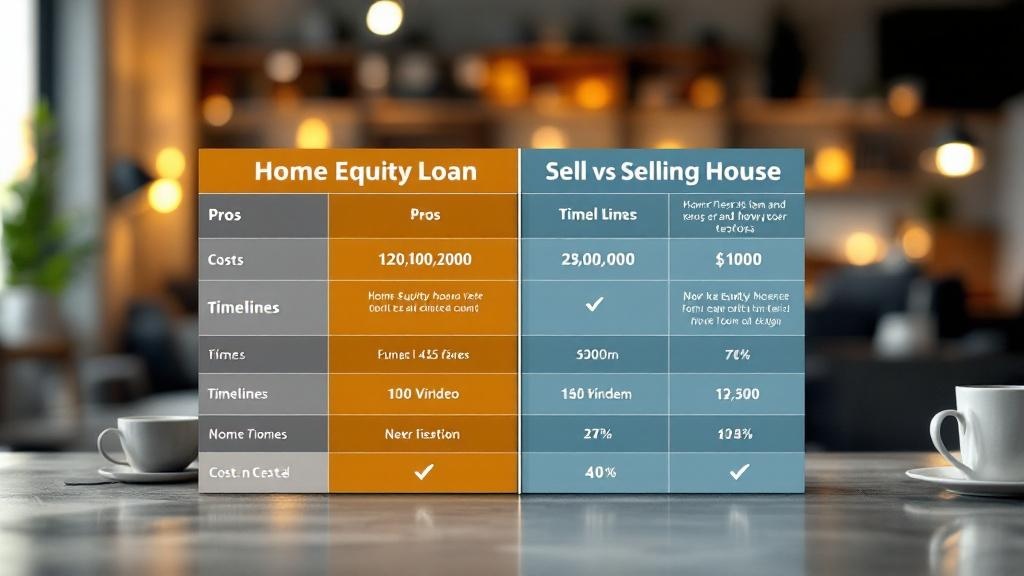
| Factor | Home Equity Loan | HELOC | Cash Sale |
|---|---|---|---|
| Timeline | 45-60 days | 30-45 days | 7-14 days |
| Closing Costs | 2-5% of loan amount | $500-$1,500 | $0 (buyer pays) |
| Monthly Payments | Required | Interest-only initially | None |
| Credit Requirements | 620+ score typically | 680+ score preferred | No requirements |
| Access Amount | Up to 80% LTV | Up to 80% LTV | 100% of equity |
According to Freddie Mac data, the average home equity loan amount reached $86,000 in 2024, while average home sale proceeds exceeded $150,000 after commission and closing costs.
HELOC Pros and Cons
HELOC advantages include payment flexibility during the draw period, with interest-only payments on amounts actually borrowed. Variable rates often start lower than fixed equity loans, and unused credit lines don’t accrue interest charges.
HELOC disadvantages center on rate volatility and payment shock risks. When the draw period ends, borrowers face principal and interest payments that can double or triple monthly obligations. Lenders can freeze credit lines during economic downturns or if property values decline significantly.
Home Equity Loan Benefits/Drawbacks
Fixed-rate benefits provide payment predictability throughout the loan term, protecting against interest rate increases. Lump-sum access facilitates large purchases or debt consolidation without multiple draws and potential rate changes.
Primary drawbacks include higher rates than first mortgages and immediate full payment requirements. Closing costs range from 2-5% of the loan amount, and reduced equity cushions limit future borrowing capacity or refinancing options during market downturns.
Quick Sale Advantages
Cash sales eliminate all qualification requirements, credit checks, and income verification processes. Immediate access to full equity provides maximum financial flexibility without ongoing payment obligations or interest accumulation.
Market timing advantages allow capitalizing on peak demand periods or relocating to areas with better cost-of-living ratios. Complete debt elimination often improves credit scores and reduces stress associated with multiple monthly payment obligations.
Financial Scenarios Analysis
Financial scenario analysis requires evaluating timeline urgency, payment capacity, credit qualification status, and long-term goals to determine whether equity access or property sale optimally addresses specific financial needs and circumstances.
Different financial situations favor distinct approaches to accessing home value. Emergency scenarios requiring immediate cash often favor quick sales over lengthy loan processing periods. Investment opportunities with time-sensitive elements may justify equity borrowing costs for speed and convenience.
Need Cash for Emergencies
Medical emergencies, sudden job loss, or major home repairs create urgent cash needs that often exceed typical emergency fund reserves. HELOC processing requires 30-60 days, potentially too slow for immediate needs.
Quick cash sales provide immediate relief without monthly payment burdens during financially stressful periods. Eliminating housing payments often reduces overall financial stress while providing substantial cash reserves for emergency management.
Debt Consolidation Situations
High-interest credit card debt averaging 20-25% annual rates makes equity borrowing at 8-12% rates mathematically advantageous. Consolidating $50,000 in credit card debt through a $50,000 HELOC saves approximately $6,000-$8,500 annually in interest costs.
Consider debt-to-income ratios carefully, as adding mortgage debt while maintaining credit card minimums may exceed lender qualification thresholds. Complete debt elimination through property sales often provides superior long-term financial outcomes for severely over-leveraged borrowers.
Investment Opportunities
Real estate investment opportunities or business ventures may justify leveraging home equity when expected returns exceed borrowing costs. Rental property investments generating 8-12% annual returns can profitably utilize equity loans costing 8-10%.
Risk assessment remains critical, as investment failures could jeopardize primary residence ownership. Conservative investors often prefer selling existing properties to fund new investments without leveraging primary residences, maintaining housing security regardless of investment outcomes.
Retirement Planning
Retirement planning scenarios vary significantly based on age, income sources, and housing preferences. Downsizing through property sales often provides optimal outcomes for retirees seeking reduced maintenance responsibilities and lower ongoing housing costs.
Reverse mortgages allow aging in place while accessing equity, but complex terms and high fees often make downsizing sales more financially advantageous. Geographic arbitrage through relocation to lower-cost areas maximizes retirement purchasing power using sale proceeds.
Explore Your Home Equity Options Today
Whether you need quick cash or want to explore all possibilities, First Choice Home Sale provides no-obligation consultations and fast cash offers for immediate decision-making clarity.
Call (866) 643-5829 now for your personalized analysis
Qualification Requirements Comparison
Equity loans require credit scores above 620, verified income, low debt-to-income ratios, and substantial existing equity, while cash sales require no qualifications, credit checks, or income verification regardless of financial circumstances.
Qualification requirements create significant barriers for homeowners with credit challenges, employment gaps, or high debt-to-income ratios. Traditional lending standards exclude many property owners who could benefit from accessing their accumulated equity through alternative methods.
Equity Loan Credit Requirements
Minimum credit scores typically range from 620-680 depending on the lender and loan-to-value ratio requested. Recent late payments, collections, or credit inquiries negatively impact approval odds and interest rate offerings.
Bankruptcy requires 2-4 years of seasoning depending on the chapter filed, while foreclosure histories require 3-7 years before equity loan eligibility. Credit history length of at least 3-5 years provides optimal approval chances with competitive rate offerings.
Income Verification Needs
Employment verification requires 2 years of consistent employment history with current employer verification. Tax returns, pay stubs, and bank statements document income stability and debt service capacity for underwriting analysis.
Debt-to-income ratios typically cannot exceed 43% including the new equity loan payment. Self-employed borrowers face additional documentation requirements including profit-and-loss statements, business tax returns, and cash flow analysis over extended periods.
Cash Sale No-Qualification Benefits
Cash buyers require no credit checks, income verification, or debt-to-income analysis. Property condition, title issues, or seller financial circumstances don’t impact purchase decisions or pricing negotiations.
This accessibility proves invaluable for homeowners facing foreclosure, divorce, job loss, or other financial challenges that prevent traditional lending qualification. Immediate cash access without qualification delays often prevents foreclosure and credit damage.
Timeline and Access Speed
HELOC processing requires 30-60 days for approval and funding, equity loans need 45 days average, while cash sales complete in 7-14 days from offer acceptance to closing with immediate fund availability.
Timeline differences significantly impact decision-making for urgent financial needs. Traditional lending processes involve multiple steps, documentation requirements, and approval delays that may not align with immediate cash requirements or time-sensitive opportunities.
HELOC Processing Time (30-60 Days)
Application processing begins with documentation gathering including income verification, property appraisal scheduling, and credit analysis. Appraisal completion typically requires 1-2 weeks depending on appraiser availability and property complexity.
Underwriting review adds 2-3 weeks for file analysis, condition resolution, and final approval. Credit line establishment and closing preparation extend timelines before draw period activation allows fund access.
Equity Loan Timeline (45 Days)
Documentation requirements mirror HELOC processes but include additional closing preparation for lump-sum distribution. Property appraisal, title search, and insurance verification must complete before underwriting approval.
Closing scheduling depends on attorney or title company availability, with fund disbursement occurring at closing completion. Rush processing may reduce timelines by 1-2 weeks for additional fees, but standard processing remains 6-7 weeks average.
Cash Sale Speed (7-14 Days)
Property evaluation and offer presentation occur within 24-48 hours of initial contact. Minimal paperwork requirements eliminate lengthy documentation gathering and verification processes.
Title searches proceed immediately upon offer acceptance, with closing scheduling within days rather than weeks. Expedited closing processes provide immediate fund access upon transaction completion, offering maximum speed for urgent financial needs.
Risk Assessment
Home equity borrowing carries market volatility, interest rate, and payment default risks that could result in foreclosure, while selling eliminates ongoing risks by converting property value to liquid assets immediately.
Risk evaluation requires understanding potential negative outcomes and their likelihood under different economic scenarios. Equity borrowing creates ongoing payment obligations and market exposure, while selling transfers all property-related risks to buyers immediately upon closing.
According to RealtyTrac data, homes with equity loans face foreclosure rates 15% higher than properties without secondary mortgages during economic downturns.
Market Risk Factors
Property value declines create underwater mortgage situations where total debt exceeds property value. This scenario limits refinancing options and creates negative equity requiring cash payments for relocation or downsizing needs.
Local market conditions significantly impact risk levels, with volatile markets like resort areas or economically dependent regions facing higher decline possibilities than diverse metropolitan areas with stable employment bases and population growth.
Interest Rate Risks
HELOC variable rates create payment volatility as Federal Reserve policy changes affect borrowing costs. Payment increases from 6% to 10% rates can double monthly obligations, creating affordability challenges for fixed-income households.
Rate environment changes over 10-15 year loan terms create long-term uncertainty. Historical rate cycles show potential for 5-8% rate swings during economic cycles, significantly impacting total borrowing costs and payment affordability.
Payment Obligation Risks
Default consequences include foreclosure possibilities that could eliminate all accumulated equity and damage credit scores for 7+ years. Job loss, medical emergencies, or economic downturns increase default risks when payment obligations exceed available income.
Additional monthly payments reduce financial flexibility for other emergencies or opportunities. Fixed payment obligations continue regardless of income changes, creating stress during unexpected financial challenges or retirement income reductions.
Orange County Market Considerations
Orange County’s high property values, competitive lending environment, and strong cash buyer demand create unique opportunities for both equity access and quick sales, with market timing significantly impacting optimal strategies.
Orange County’s premium real estate market provides substantial equity accumulation opportunities but also creates unique challenges for accessing that value. High property values often translate to large equity amounts, making both borrowing and selling attractive options.
Local Property Values
Orange County median home prices reached $1.1 million in 2024, with coastal areas averaging $2-3 million and inland communities ranging $800,000-$1.2 million. This premium pricing creates substantial equity positions for long-term owners.
Neighborhood variations create different equity access opportunities, with luxury markets offering higher loan amounts but facing greater volatility during economic downturns. Condo markets provide entry-level equity building with different appreciation patterns than single-family detached properties.
Interest Rate Environment
Current HELOC rates in Orange County range 7.75-9.25% depending on creditworthiness and loan-to-value ratios. Local credit unions often provide competitive alternatives with rates 0.5-1% below national bank offerings for qualified members.
Regional lending competition creates favorable terms for high-value properties and well-qualified borrowers. Portfolio lenders specializing in jumbo products often provide more flexible underwriting for complex income situations common among high-net-worth borrowers.
Cash Buyer Demand
Cash sales represent approximately 25% of Orange County transactions, well above national averages of 18-20%. Strong investor demand and relocating buyers with substantial assets create competitive environments favoring cash transactions.
Premium pricing for quick sales ranges 2-5% above market value depending on property condition, location, and timing. This premium often exceeds the costs and delays associated with equity borrowing for homeowners requiring immediate liquidity.
Decision Framework Tool
Effective decision-making requires systematic evaluation of timeline needs, qualification status, risk tolerance, financial goals, and market conditions using structured analysis rather than emotional or impulsive choices.
A comprehensive decision framework helps homeowners evaluate their specific circumstances against the advantages and disadvantages of each equity access method. This systematic approach prevents costly mistakes and ensures optimal outcomes aligned with individual financial goals and constraints.
Questions to Ask Yourself
Financial Goal Assessment: Do you need immediate cash access or can you wait 30-60 days for processing? Are you seeking to eliminate debt entirely or simply access capital for investment or emergency purposes?
Qualification Evaluation: Does your credit score exceed 620, and can you document 2 years of stable income? Are your current debt payments less than 35% of gross monthly income before adding equity loan payments?
Risk Tolerance Analysis: Can you comfortably afford additional monthly payments ranging $500-2,000 depending on equity accessed? How would payment increases from variable rate changes impact your monthly budget and financial security?
Timeline Requirements: Do urgent financial needs require immediate cash access, or do investment opportunities allow time for traditional lending processes? Are there seasonal market considerations affecting optimal timing for sales versus equity access?
Future Planning Considerations: Do you plan to remain in your current home long-term, or are relocation, downsizing, or lifestyle changes anticipated within 5 years? How important is maintaining maximum financial flexibility versus accessing specific capital amounts?
Market Timing Factors: Are current market conditions favorable for selling at premium prices, or do seasonal or economic factors suggest waiting for better timing? How do current interest rates compare to historical averages and your comfort with potential rate increases?
Professional Consultation Needs
Mortgage brokers provide valuable comparison shopping across multiple lenders, often securing better rates and terms than direct bank applications. Their expertise proves especially valuable for complex income situations or credit challenges requiring specialized lending products.
Financial advisors help evaluate tax implications, investment alternatives, and long-term wealth building strategies. Professional guidance often identifies overlooked opportunities or risks that significantly impact optimal decision-making.
Real estate professionals provide market timing insights, property valuation expertise, and transaction management services. Tax professionals ensure understanding of deductibility rules, capital gains implications, and overall tax strategy alignment with equity access or sale decisions.
Frequently Asked Questions
Should I sell my house or get a HELOC for emergency cash?
For emergency cash needs, timeline urgency often determines the best option. HELOCs require 30-60 days processing while cash sales complete in 7-14 days. If you can afford additional monthly payments and qualify creditwise, a HELOC preserves homeownership. For immediate needs or qualification challenges, selling provides faster, guaranteed access to your full equity.
How fast can I get cash from home equity compared to selling?
HELOC funding takes 30-60 days, home equity loans require 45 days, and cash-out refinancing needs 45-60 days. Cash sales close in 7-14 days with immediate fund access. Emergency situations requiring immediate cash often favor quick sales over waiting for equity loan processing and approval.
What credit score do I need for a home equity loan vs selling?
Home equity loans typically require 620+ credit scores, while HELOCs prefer 680+ scores. Cash sales require no credit checks or qualification requirements regardless of credit history, bankruptcy, or income challenges. This makes selling accessible when equity borrowing isn’t available due to credit issues.
Can I access more money by selling vs taking an equity loan?
Equity loans typically allow borrowing up to 80% of home value minus existing mortgage balance. Selling provides 100% equity access minus commission and closing costs (typically 6-8% total). For a $800,000 home with a $300,000 mortgage, equity loans might provide $140,000 while selling could net $460,000 after costs.
What happens if I can’t make equity loan payments?
Defaulting on equity loans can result in foreclosure, potentially losing all accumulated home equity and damaging credit scores for 7+ years. Selling eliminates payment obligations entirely, providing financial security without ongoing monthly payment risks during uncertain economic periods or income changes.
Is it better to sell now or wait and get a HELOC later?
Market timing, interest rate trends, and personal circumstances determine optimal timing. Current high property values in Orange County may favor selling, while rising interest rates increase future equity borrowing costs. Personal financial urgency, qualification status, and long-term housing plans should guide timing decisions rather than market predictions alone.
Ready to Access Your Home Equity?
First Choice Home Sale offers free consultations to help you understand all your options. Whether you choose equity borrowing or quick sale, we provide expert guidance for optimal financial outcomes.
Contact First Choice Home Sale at (866) 643-5829 for your personalized equity strategy session
The choice between home equity vs selling house depends on your specific financial situation, timeline requirements, and risk tolerance. Each option provides distinct advantages and challenges that must align with your individual circumstances and goals.
Understanding qualification requirements, timeline differences, and risk factors enables informed decision-making that optimizes your financial outcomes. Whether accessing equity through borrowing or converting property value to cash through sale, professional guidance ensures you choose the strategy that best serves your long-term financial security and immediate needs.