Selling your home involves choosing between a cash offer vs traditional sale, each with distinct advantages, timelines, and costs. Cash sales typically close within 7-14 days with fewer contingencies, while traditional financed sales take 30-60 days but may yield higher prices. Understanding the differences helps sellers make informed decisions based on their priorities, property condition, and market circumstances.
Get a no-obligation cash offer within 24 hours. First Choice Home Sale buys houses in any condition throughout Orange County.
Call (866) 643-5829 for your free consultation today.
- Cash offers close 3-4 times faster than traditional financed sales (7-14 days vs 30-60 days)
- Traditional sales typically yield 5-10% higher prices but involve realtor commissions and carrying costs
- Cash sales eliminate financing contingencies, reducing deal failure risk from 5% to under 1%
- Property condition heavily influences sale type choice – distressed properties favor cash sales
- Orange County cash sales represent 28% of transactions, above the national average of 24%
- Net proceeds often favor cash sales when factoring in fees, time costs, and certainty
Cash Offers vs Traditional Sales: Key Differences
Cash offers involve buyers purchasing with available funds without financing, eliminating loan contingencies and enabling faster closings, while traditional sales require mortgage approval with extended timelines and multiple contingencies.
The fundamental difference between cash offer vs traditional sale lies in the financing structure and resulting transaction complexity. Cash buyers provide proof of funds and can close quickly, while traditional buyers depend on mortgage approval, appraisals, and underwriting processes.
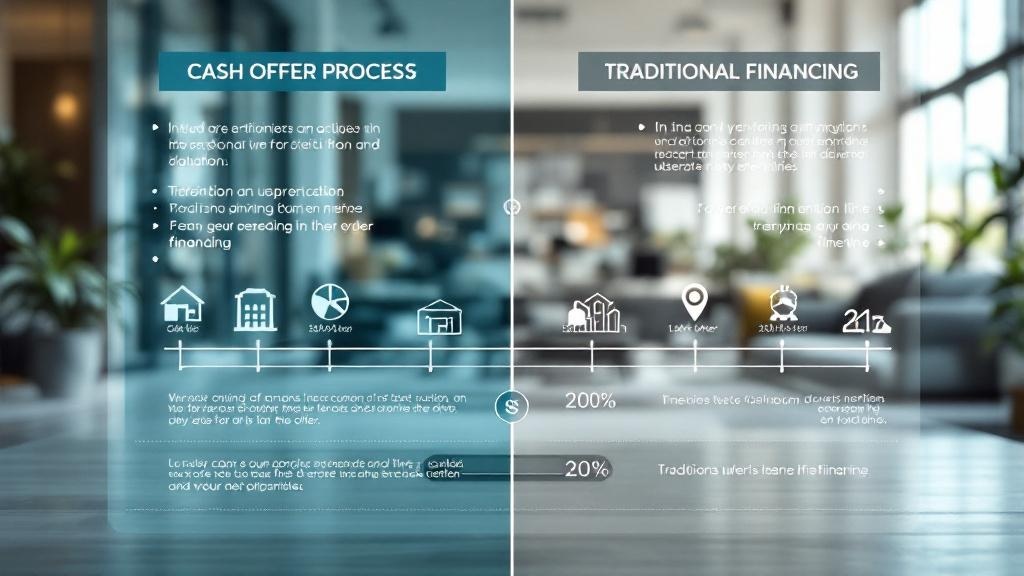
| Factor | Cash Offers | Traditional Sales |
|---|---|---|
| Average Timeline | 7-14 days | 30-60 days |
| Financing Contingency | None | Required |
| Appraisal Required | Optional | Mandatory |
| Deal Failure Rate | Under 1% | 4-5% |
| Buyer Pool Size | Limited | Extensive |
| Price Premium | Lower | Higher |
Definition and Process Overview
Cash offers represent transactions where buyers purchase properties using available liquid funds without requiring mortgage financing. These buyers typically include investors, companies like cash home buyers guide, or individuals with substantial savings.
Traditional sales involve buyers obtaining mortgage financing through banks, credit unions, or other lending institutions. This process requires extensive documentation, credit verification, income validation, and property appraisals.
Cash sale processes begin with proof of funds verification, followed by property inspection, title examination, and closing preparation. Documentation requirements include bank statements and investment account statements.
Traditional sale processes start with buyer pre-approval, followed by offer submission, loan application, underwriting, appraisal scheduling, and final loan approval. Each step introduces potential delays and complications.
The streamlined nature of cash transactions eliminates multiple intermediaries, reducing coordination complexity and potential failure points throughout the selling process.
Market Statistics and Trends
According to the National Association of Realtors, cash sales comprised 24% of all residential transactions in 2024, representing a slight increase from 23% in 2023.
Cash buyers completed 26% of existing home sales in August 2024, with the highest concentrations in markets with strong investor activity and seasonal buyer patterns, according to NAR market research.
Regional variations show cash sale percentages ranging from 15% in first-time buyer markets to over 35% in luxury and investment-heavy regions. California markets consistently exceed national averages due to high property values and investor activity.
Investment companies and institutional buyers drive significant cash purchase volume, particularly in markets with distressed properties or rental investment opportunities. These buyers often target properties requiring repairs or facing time-sensitive selling situations.
Market trends indicate cash buyer activity increases during economic uncertainty, as financing becomes more restrictive and sellers prioritize transaction certainty over maximum pricing.
Timeline Comparison
Cash sales close in 7-14 days on average, while traditional financed sales require 30-60 days due to loan processing, underwriting, appraisals, and potential delays in the mortgage approval process.
Timeline differences represent the most significant distinction between sale types, directly impacting seller planning and financial outcomes. Understanding these timelines helps sellers align expectations with their specific circumstances and deadlines.

| Timeline Milestone | Cash Sale | Traditional Sale |
|---|---|---|
| Offer to Contract | 1-2 days | 1-3 days |
| Inspection Period | 2-5 days | 7-10 days |
| Financing Approval | N/A | 15-30 days |
| Appraisal Process | Optional | 7-14 days |
| Title/Closing Prep | 3-7 days | 5-10 days |
| Total Average | 10 days | 45 days |
Cash Sale Timeline (7-14 Days)
Day 1-2: Offer acceptance and contract execution occur rapidly, with cash buyers often providing same-day proof of funds verification. Initial deposit typically accompanies signed purchase agreements.
Day 3-5: Property inspections proceed immediately, with cash buyers conducting due diligence on property condition, title status, and any potential issues requiring attention.
Day 6-8: Title company begins title examination and preparation of closing documents. Cash buyers coordinate with title officers to schedule closing and address any title concerns.
Day 9-14: Final walkthrough, document signing, and fund transfer complete the transaction. Cash transactions avoid lending delays, enabling flexible closing scheduling based on seller and buyer convenience.
Expedited timelines benefit sellers facing foreclosure, relocation deadlines, or estate settlement requirements where quick closings provide crucial financial relief.
Traditional Sale Timeline (30-60 Days)
Week 1-2: Offer acceptance triggers buyer loan application submission, requiring extensive documentation including income verification, asset statements, and credit authorization. Appraisal scheduling occurs during this period.
Week 3-4: Underwriting review begins as lenders analyze borrower qualifications and property information. Appraisal completion and review may reveal valuation issues requiring price negotiations.
Week 5-6: Final underwriting approval depends on satisfactory appraisal results, employment verification, and resolution of any conditions identified during the review process.
Week 7-8: Closing preparation includes final loan approval, document preparation, and coordination between multiple parties including lenders, title companies, and real estate agents.
Additional delays commonly occur due to underwriting conditions, appraisal complications, employment changes, or documentation requirements that extend timelines beyond initial estimates.
Factors That Affect Closing Speed
Title issues significantly impact both sale types, though cash buyers often accept properties with minor title complications that might discourage financed buyers requiring lender approval.
Property condition affects inspection timelines and negotiation periods. Distressed properties may require extensive inspection time for traditional buyers but streamlined review for cash buyers purchasing as-is properties.
Market conditions influence timeline predictability, with busy periods creating scheduling delays for appraisers, inspectors, and closing services. Cash sales maintain more consistent timelines regardless of market volume.
Documentation complexity varies by transaction, with estate sales, trust properties, or corporate ownership requiring additional legal review that can extend closing preparation periods.
Skip repairs, inspections, and lengthy processes. We buy houses as-is throughout Orange County with fast cash closings.
Get your cash offer: Call (866) 643-5829
Cost Analysis Breakdown
Cash sales eliminate realtor commissions (5-6%) and reduce closing costs, though prices may be 5-10% lower. Traditional sales involve higher fees but potentially greater gross proceeds, requiring careful net proceeds analysis.
Cost analysis reveals complex trade-offs between immediate savings and potential price premiums. Sellers must evaluate total transaction costs, carrying expenses, and opportunity costs when comparing sale methods.

| Cost Category | Cash Sale | Traditional Sale |
|---|---|---|
| Realtor Commission | $0 | 5-6% of sale price |
| Staging/Marketing | $0 | $2,000-$5,000 |
| Title Insurance | $800-$1,500 | $800-$1,500 |
| Escrow Fees | $500-$1,000 | $500-$1,000 |
| Transfer Tax | $1.10 per $1,000 | $1.10 per $1,000 |
| Carrying Costs | Minimal (2 weeks) | Significant (2+ months) |
Cash Sale Costs and Fees
Title insurance costs range from $800-$1,500 depending on property value, protecting against title defects and ensuring clear ownership transfer. Cash buyers and sellers typically split these costs.
Escrow fees average $500-$1,000 for neutral third-party handling of funds and documents. These fees remain consistent regardless of financing method.
Transfer taxes in California equal $1.10 per $1,000 of sale price, with some cities imposing additional transfer fees. These government-mandated costs apply to all property transfers.
Repair credits or price adjustments may apply when cash buyers identify property issues during inspections. However, many cash buyers purchase properties in as-is condition, eliminating repair negotiation costs.
Attorney fees for complex transactions typically range from $500-$2,000, though many cash sales proceed without requiring legal representation beyond title company services.
Traditional Sale Costs and Fees
Realtor commissions represent the largest traditional sale expense, averaging 5-6% of sale price split between listing and buyer agents. On a $600,000 Orange County home, commissions total $30,000-$36,000.
Home staging costs range from $2,000-$5,000 monthly, including furniture rental and professional styling to enhance property presentation. Multiple months on market multiply these expenses significantly.
Marketing expenses include professional photography ($300-$800), virtual tours ($200-$500), and listing syndication fees. Premium marketing packages can exceed $2,000 for luxury properties.
Carrying costs accumulate throughout extended marketing periods, including mortgage payments, property taxes, insurance, and utilities. Two months of carrying costs on a $600,000 property often exceed $4,000.
Buyer concessions and repair credits frequently arise from traditional sale negotiations, with sellers commonly contributing 1-3% of sale price toward buyer closing costs or property improvements.
Net Proceeds Comparison Calculator
Example calculation for $600,000 Orange County property:
Cash Sale: $570,000 purchase price (5% below market), minus $3,000 closing costs = $567,000 net proceeds in 10 days.
Traditional Sale: $600,000 purchase price, minus $33,000 realtor commission, minus $3,000 staging, minus $3,000 closing costs, minus $4,000 carrying costs = $557,000 net proceeds in 60 days.
The cash sale provides $10,000 additional net proceeds despite lower gross price, demonstrating the importance of comprehensive cost analysis rather than focusing solely on sale price.
Property condition significantly impacts calculations, with distressed properties often requiring substantial repair investments for traditional sales but selling as-is to cash buyers.
Time value of money considerations favor faster transactions, as sellers can reinvest proceeds or eliminate carrying costs immediately rather than waiting months.
Financing Contingencies Explained
Financing contingencies protect buyers by allowing contract cancellation if loan approval fails, but create seller risks as 4-5% of traditional sales fall through due to financing issues, compared to under 1% for cash sales.
Financing contingencies represent contractual provisions allowing buyers to cancel purchase agreements if they cannot secure mortgage approval within specified timeframes. These contingencies protect buyer interests but introduce transaction uncertainty for sellers.
Understanding contingency mechanisms helps sellers evaluate offer strength and potential completion risks when choosing between cash and traditional buyers.
How Loan Contingencies Work
Loan contingencies typically provide 21-30 days for buyers to secure financing approval, during which sellers cannot accept backup offers or continue marketing. Buyers must demonstrate good faith efforts to obtain financing.
Contingency removal occurs when buyers provide written notice of loan approval, making the contract binding regardless of subsequent financing changes. Early contingency removal strengthens buyer positions.
If financing fails, buyers can cancel contracts and recover earnest money deposits, provided they followed contingency procedures correctly. Sellers then return to market, having lost valuable time.
Extension requests may occur when underwriting delays prevent timely approval, forcing sellers to choose between granting extensions or canceling contracts and restarting the selling process.
Appraisal Contingency Risks
Appraisal contingencies allow buyers to renegotiate or cancel if property values come in below contract prices. According to CoreLogic, 8% of purchase appraisals in 2024 came in below contract price.
Appraisal issues affected 8.2% of purchase transactions in 2024, with the highest incidence in rapidly appreciating markets where list prices may exceed recent comparable sales data, according to CoreLogic market analysis.
Low appraisal scenarios create three options: sellers reduce prices to appraised values, buyers pay differences in cash, or contracts cancel due to unresolved valuation gaps.
Appraisal appeals processes allow sellers to challenge valuations by providing additional comparable sales data, though success rates remain limited and delay closing timelines further.
Cash Offer Advantages
Cash offers eliminate financing risk entirely, providing sellers with transaction certainty unavailable in traditional sales. This certainty becomes crucial for sellers facing tight deadlines or financial pressure.
Competitive advantages in multiple offer situations often favor cash buyers, as sellers prioritize deal completion over maximum pricing when facing comparable offers.
Flexibility in closing timing allows cash buyers to accommodate seller preferences, including extended possession periods or accelerated timelines matching seller requirements.
Simplified due diligence processes enable cash buyers to waive appraisal contingencies when purchasing investment properties or distressed assets where condition matters more than precise valuations.
When to Choose Each Option
Choose cash sales for speed, certainty, and distressed properties requiring significant repairs. Select traditional sales for maximum pricing, excellent property condition, and flexible timing without urgent deadlines.
Decision-making requires careful evaluation of seller priorities, property characteristics, and market conditions. Each sale type serves different seller needs optimally.
Best Scenarios for Cash Sales
Time-sensitive situations favor cash sales, including foreclosure prevention, estate settlements, job relocations, or divorce proceedings requiring rapid asset liquidation. Traditional sale timelines often cannot accommodate urgent deadlines.
Property condition issues make cash sales attractive when homes require extensive repairs, have structural problems, or contain health hazards. Traditional buyers typically avoid such properties.
Avoiding showings appeals to sellers preferring privacy, dealing with tenant-occupied properties, or maintaining current living situations without disruption from buyer tours.
Estate sale situations benefit from cash transactions when heirs prefer quick asset distribution over prolonged marketing periods requiring ongoing property maintenance.
Market uncertainty periods when economic conditions threaten buyer financing availability favor the certainty of immediate cash sales.
When Traditional Sales Make Sense
Price maximization priorities suit sellers with excellent property condition, desirable locations, and flexible timing who can invest in staging and marketing to achieve premium pricing.
Strong market conditions with low inventory and high buyer demand create environments where traditional sales can significantly exceed cash offer pricing through competitive bidding.
Move-up buyers seeking to optimize sale proceeds for subsequent purchase deposits often prefer traditional sales despite longer timelines.
Properties with unique features, luxury amenities, or specialized appeal typically perform better with traditional marketing to reach appropriate buyer segments.
Stable personal situations without time pressure allow sellers to navigate traditional sale complexities while pursuing maximum financial returns.
Property Condition Considerations
Well-maintained properties with updated systems and cosmetic appeal typically achieve better pricing through traditional sales, as financed buyers can appreciate and pay for improvements.
Distressed properties with significant repair needs often receive better net proceeds through cash sales, avoiding costs and complications of bringing properties to traditional sale standards.
Properties with title issues, legal complications, or regulatory violations may require specialized cash buyers who can navigate complex situations traditional buyers cannot handle.
Orange County Market Insights
Orange County cash sales represent 28% of transactions, above the 24% national average, driven by high property values, investor activity, and proximity to tech wealth creating strong cash buyer demand.
Orange County’s unique market dynamics influence cash vs traditional sale decisions, with luxury home concentrations and investor activity creating distinct patterns compared to national trends.
Local Cash Sale Statistics
Orange County cash sales comprised 28.3% of transactions in 2024, significantly exceeding the national average of 24%. Luxury markets in Newport Beach and Laguna Beach show cash sale rates approaching 40%.
Orange County luxury home sales above $2 million showed 42% cash transactions in Q3 2024, reflecting strong investor and high-net-worth buyer activity in premium coastal markets, according to MLS data analysis.
Average days on market for cash sales: 12 days versus 35 days for traditional sales. Price differentials typically range from 3-8% below market value, varying by location and property condition.
Investment property concentrations in areas like Anaheim and Garden Grove attract cash buyers seeking rental opportunities, driving above-average cash sale percentages.
Seasonal patterns show increased cash activity during winter months when traditional buyer pools contract, creating opportunities for sellers preferring certainty.
Buyer Competition Factors
Multiple offer situations increasingly favor cash buyers, with 67% of cash offers being accepted compared to 54% acceptance rates for traditional financing offers in competitive Orange County markets.
Tech industry wealth concentration creates cash buyer pools for primary residences, not just investment properties. These buyers often compete aggressively for properties in top school districts.
Investor activity from both local and out-of-state buyers maintains consistent cash buyer demand, providing sellers with alternatives when traditional buyer markets contract.
International buyers, particularly from Asia-Pacific regions, maintain significant cash buyer presence in Orange County, creating year-round demand independent of domestic financing conditions.
Risk Assessment Comparison
Cash sales show 99%+ completion rates while traditional sales complete 95-96% of the time. Financing failures, appraisal issues, and buyer qualification problems create the primary risks in traditional transactions.
Risk evaluation encompasses transaction completion probability, timeline reliability, and potential complications that can derail sales or create unexpected costs.
Deal Falling Through Rates
Industry data shows traditional sales fail to close 4-5% of the time, while cash sales fail under 1%. Primary failure causes include financing denial, appraisal issues, and buyer qualification changes.
National Association of Realtors data indicates 5% of pending home sales failed to close in 2024, with 64% of failures attributed to financing problems, appraisal complications, or buyer qualification issues affecting traditional sales.
Last-minute financing denials occur when underwriting discovers unreported debts, employment changes, or credit issues not identified during pre-approval. These failures typically happen weeks before closings.
Appraisal shortfalls create negotiation complications that result in transaction failures when buyers cannot or will not cover valuation gaps exceeding financing limits.
Certainty of Closing
Cash buyer verification through recent bank statements, investment account records, and certified financial institution letters provides high confidence in fund availability.
Proof of funds documentation typically includes 30-60 day account histories showing consistent balances exceeding purchase prices plus estimated closing costs.
Traditional buyer pre-approval reliability varies significantly, with initial pre-approval letters based on limited documentation that may not survive full underwriting scrutiny.
Employment verification requirements for traditional buyers create ongoing risks throughout transaction periods, as job changes or income reductions can invalidate loan approvals.
Market volatility affects traditional buyer financing availability as lenders adjust qualification criteria, interest rates, and program availability, creating unpredictable approval outcomes.
Frequently Asked Questions
How much faster is a cash sale compared to traditional financing?
Cash sales typically close in 7-14 days compared to 30-60 days for traditional sales. The elimination of loan processing, underwriting, and appraisal requirements allows cash transactions to proceed 3-4 times faster than financed purchases.
Do cash offers get accepted more often than traditional offers?
Yes, cash offers have a 67% acceptance rate compared to 54% for traditional financing offers in competitive markets. Sellers prefer the certainty and speed of cash transactions, especially when offers are comparable in price.
How much less do cash buyers typically offer?
Cash offers typically range 5-10% below market value, but sellers often net more due to eliminated commissions, reduced carrying costs, and faster timelines. The exact discount varies by property condition, location, and market conditions.
What happens if a traditional sale falls through?
Failed traditional sales require sellers to return to market, having lost 30-60 days of marketing time. Sellers must restart showings, renegotiate with new buyers, and potentially face market changes that occurred during the failed transaction period.
Can I sell my house as-is to a cash buyer?
Yes, most cash buyers purchase properties in as-is condition without requiring repairs. This eliminates preparation costs, contractor coordination, and renovation delays that traditional sales often require for maximum pricing.
Are there any disadvantages to cash sales?
Cash sales typically yield lower gross prices and have smaller buyer pools. However, reduced transaction costs, faster timelines, and elimination of deal failure risks often offset lower pricing for sellers prioritizing certainty and convenience.
When choosing between a cash offer vs traditional sale, consider your priorities carefully. Cash sales provide speed, certainty, and convenience ideal for time-sensitive situations or distressed properties. Traditional sales potentially offer higher gross proceeds but involve extended timelines, commission costs, and completion risks. Orange County sellers benefit from strong cash buyer activity, making both options viable depending on individual circumstances.
First Choice Home Sale has helped thousands of Orange County homeowners navigate these decisions successfully. Our experienced team understands local market conditions and can provide personalized guidance based on your specific situation and goals.
Whether you choose cash or traditional sale, First Choice Home Sale provides expert guidance and guaranteed cash offers when you need them.
Call (866) 643-5829 to discuss your options with our experienced team today.